


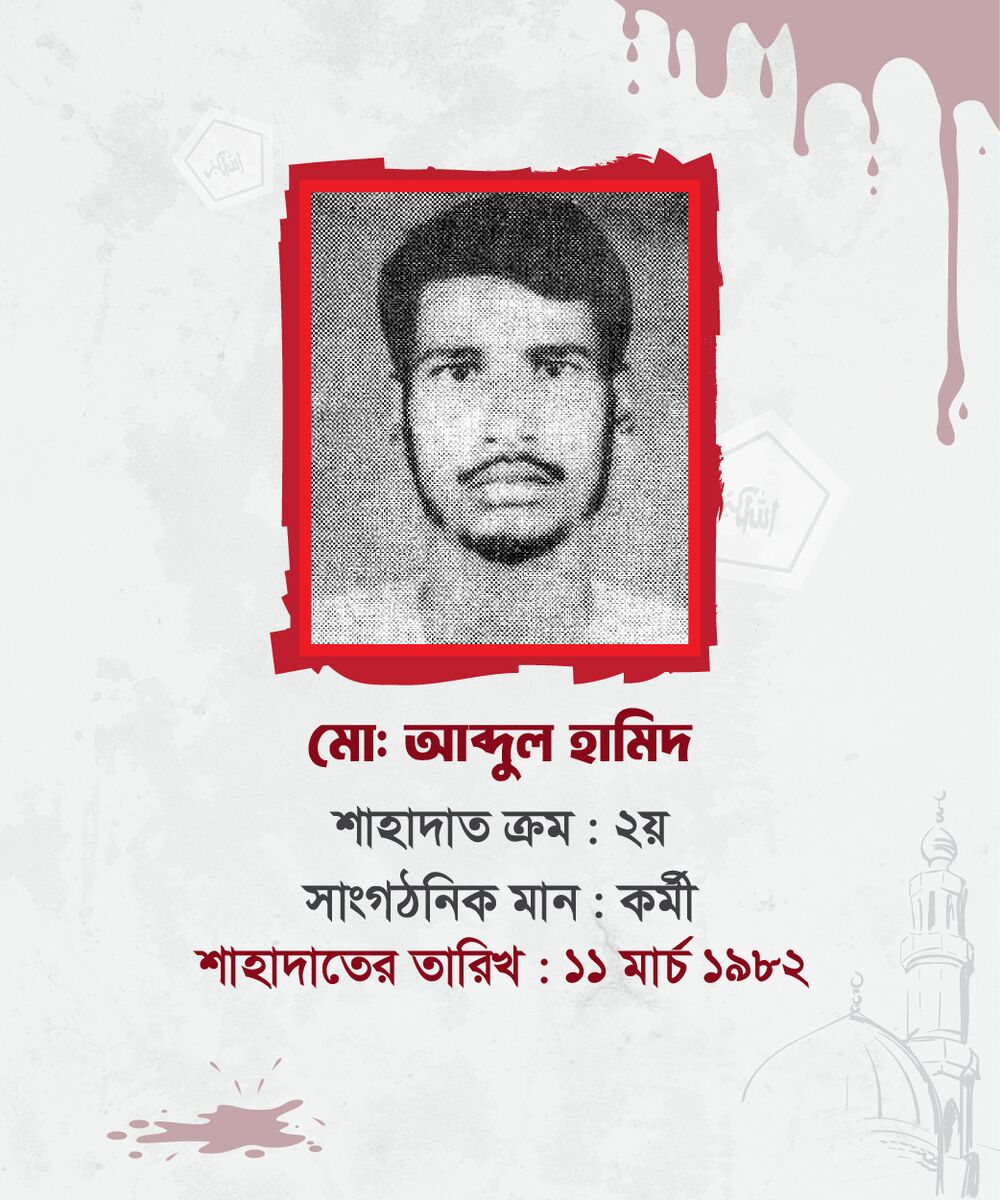
Shaheed Abdul Hamid
30 November 1963 – 11 March 1982 | 2
The Incident of Martyrdom
The conflict between truth and falsehood has existed since the dawn of human history. Throughout the ages, the devoted and courageous servants of Allah have exerted relentless efforts to uphold eternal truth. Conversely, those who embody falsehood—who feel the sting of truth piercing their hearts like an arrow—have consistently sought to suppress it and extinguish the radiant light of Allah’s Deen.
In the era of the Prophet Muhammad (peace be upon him), the history of the Islamic movement stands unparalleled within this enduring struggle. Each chapter of that history reflects both immense resistance and extraordinary sacrifice. This tradition of martyrdom began with the martyrdom of Hazrat Sumayyah (RA) and continued through generations, as countless fearless soldiers of faith paved the path of Islamic struggle with their blood.
Shaheed Abdul Hamid was one such fearless servant of the Most Merciful. Through martyrdom, he ascended what believers describe as the golden steps toward Paradise, becoming a cherished flower in the garden of the Lord of the Worlds. Just as a gardener selects the finest flower from the garden, Allah chose Abdul Hamid as one of His beloved.
The Upbringing of Abdul Hamid
Shaheed Abdul Hamid was born in the quiet village of Syedpur in Thakurgaon district. He grew up under the loving care of his father, Nasir Uddin, and mother, Hamida Begum. As the eldest among seven siblings, he was the center of his parents’ hopes and aspirations.
With dreams in his heart, he began his educational journey. Like many rural families, his parents hoped he would study, secure employment, and bring happiness to the family. Despite being the son of a poor farmer, his determination never wavered. Amid severe hardships, he completed Dakhil from Danarhat Madrasa and earned Alim, Fazil, and Kamil degrees with distinction from Jaipur Alia Madrasa. He also passed his HSC from Jaipur College.
His thirst for knowledge did not end there. Seeking higher education, he moved to Rajshahi and enrolled in the Arabic Department at Rajshahi Government College, marking a new chapter in his life.
A Traveler on a Difficult Path
From an early age, Abdul Hamid demonstrated deep commitment to the Islamic movement. While studying in the eighth grade, he joined the ranks of Islami Chhatra Shibir, aware that the path ahead was full of obstacles and hardships.
Believing that “participation in the Islamic movement is an essential demand of faith,” he prepared himself to sacrifice everything for this cause. He believed that true success lay not in worldly luxury but in dedicating one’s life to the path of Allah. According to his supporters, Allah accepted this silent aspiration and granted him martyrdom.
Voice Against Injustice and Service to Society
Shaheed Abdul Hamid was known for speaking out against injustice. Whenever he witnessed wrongdoing, he would protest firmly and advise others to avoid such acts. His character reflected moral refinement and sincerity.
He was attentive to the rights of neighbors and helped the poor within his means. During illness or hardship, he ensured medical support and assistance. His conduct made him respected in the community.
A Symbol of Islamic Ideals
In daily life, Abdul Hamid sought to reflect Islamic values through his behavior, speech, and personal discipline. From a young age, he was regular in prayer and encouraged family members and peers to pray. He often spoke publicly about establishing a just Islamic society.
He organized fundraising for religious gatherings and helped establish an Ebtedayi madrasa in his village, which still exists today as Syedpur Shahidia Madrasa. In his memory, a Shahidia Primary School and the Shaheed Abdul Hamid Memorial Library were later established in Syedpur.
He lived simply, remained content with what he had, and maintained cleanliness and order in his personal life. He planted fruit and flower trees around his home and encouraged others to do the same. He consistently wore traditional attire and maintained a beard throughout his life.
In an area once troubled by theft and robbery, he courageously worked to ensure safety. He would put his younger brothers to sleep and remain awake to guard the household.
The Context of His Martyrdom
On Thursday, 11 March 1982, Islami Chhatra Shibir organized a reception for new students at Rajshahi University. The objective was to introduce the ideals of the Islamic movement to new students and strengthen organizational presence on campus.
According to reports from Shibir sources, opposition groups associated with leftist and secular student organizations allegedly conspired to disrupt the program. Promotional activities the previous day faced obstruction. Despite provocation, Shibir activists reportedly exercised restraint.
On the day of the event, armed individuals allegedly gathered near the Central Shaheed Minar while hundreds of students assembled at the program venue. Tensions escalated. Clashes broke out. Armed attackers reportedly surrounded Shibir activists and launched violent assaults using sharp weapons and rods. The program collapsed amid chaos.
Abdul Hamid Joins the “Procession of Martyrs”
Many activists sought refuge inside the BNCC building near the main gate. According to accounts from supporters, attackers surrounded the building. When they attempted to break the door, Abdul Hamid reportedly said, “This is state property; there is no need to break it. I will open it myself.”
He and others were dragged out and assaulted brutally. Witness accounts describe repeated stabbing and beating. During the assault, attackers allegedly demanded that he renounce Shibir activities in exchange for his life.
Abdul Hamid reportedly replied:
“The truth I have found, the light I have received, the path of Islam that I have embraced—I cannot abandon it.”
He sustained severe injuries and was later taken to the hospital. At 9:00 p.m., doctors declared that he had passed away.
Funeral and Public Reaction
On Friday, 12 March, thousands gathered at Rajshahi Madrasa Field for his funeral prayer. He was buried in his family graveyard.
Protests erupted across Rajshahi and other parts of the country. Various political parties and organizations issued statements condemning the violence. Editorials in newspapers highlighted the brutality of the incident. Demands were raised for administrative accountability.
A symbolic funeral prayer in absentia (Ghaibana Janaza) was held at Baitul Mukarram National Mosque in Dhaka.
Reflections of His Mother
His mother, Hamida Begum, expressed that she often dreams of him and finds solace in those dreams. She described experiences where she felt reassured by his presence in her dreams, saying he was well and at peace.
She stated that when she remembers her eldest son, she still becomes overwhelmed with emotion. She considers members of the Islamic movement as her own children and hopes they will continue what she views as her son’s unfinished work.
His Final Words
When pressured during the assault to renounce his affiliation, he reportedly declared:
“The truth I have found, the light I have received, the path of Islam that I have embraced—I cannot turn away from it.”
The Condition of His Parents
His father, unable to bear the grief, passed away three years later. His mother continues to live with the pain of losing her son.
Reactions from Family and Community
His younger brother expressed hope that future generations would continue efforts toward their ideals.
A madrasa teacher described him as respectful, well-mannered, and exemplary in conduct.
A neighbor recalled him as a good and polite young man, respected across the community.