


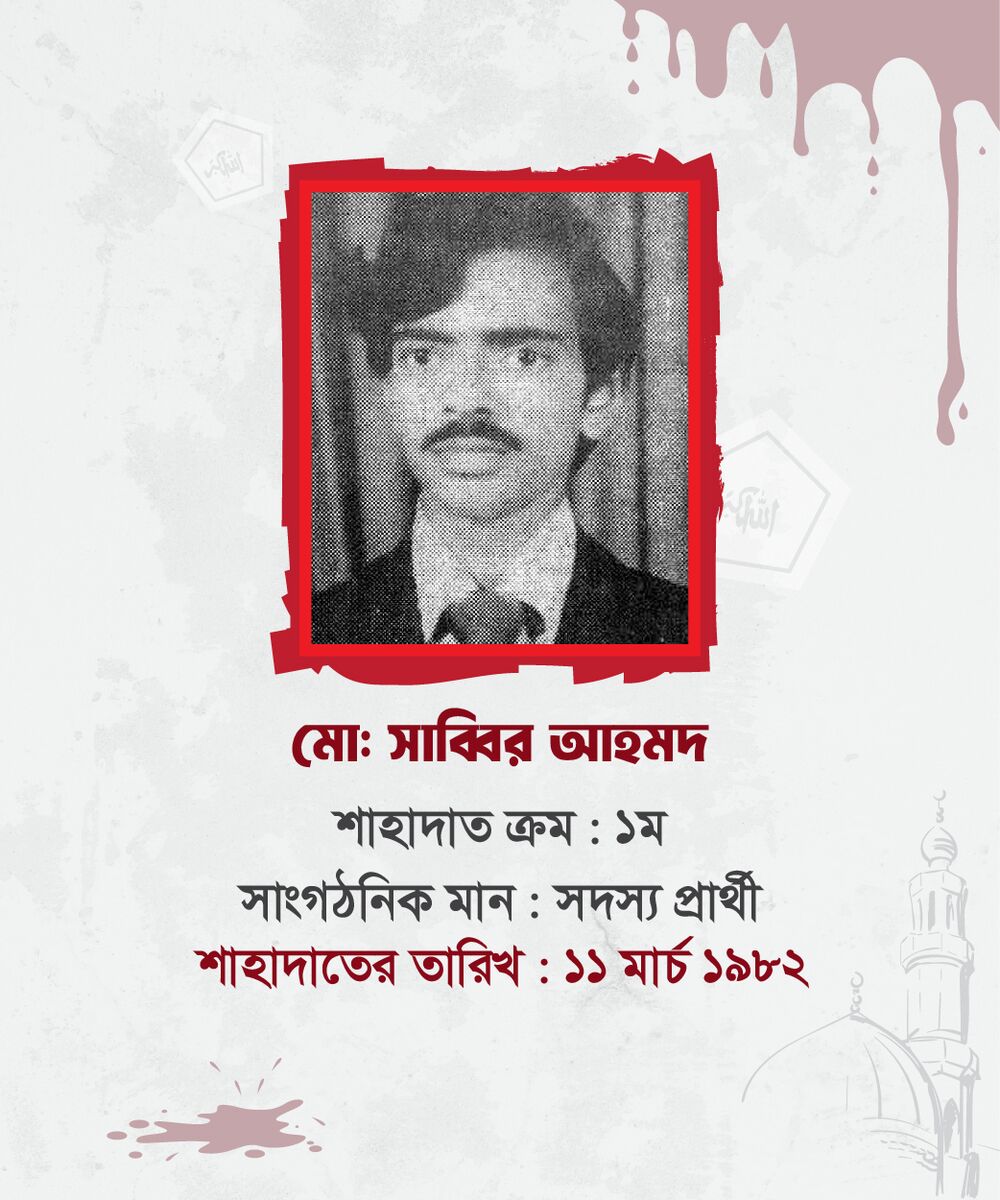
Shaheed Sabbir Ahmad
30 November 1963 – 11 March 1982
The Incident of Martyrdom
Bangladesh Islami Chhatra Shibir has been working in Bangladesh with firm determination to establish the Deen (way of life) of Allah, aiming to liberate humanity from all forms of oppression and injustice. Despite numerous obstacles, those who continue tirelessly in this movement—enduring persecution, imprisonment, and even sacrificing their lives—advance toward their desired success through immense sacrifice and dedication. Among them was Shaheed Sabbir Ahmad.
Personal Background
Md. Sabbir Ahmad was the eldest of six children of Md. Jamil Khan, a former night guard of Sonali Bank. Their home was located at A/22 in the residential area of Upashahar under Boalia Police Station in Rajshahi. In this modest yet tidy old-style house lived an 18-year-old energetic and hardworking young man—Sabbir.
Educational Life
Despite growing up in poverty, Sabbir was firmly determined to achieve his goals. To finance his education, he engaged in small businesses, including producing ink for pens and selling cosmetic items. He bore his educational expenses himself. Though he could dedicate only two to three hours daily to his studies, he passed the SSC examination with distinction in 1979.
Organizational Life
With deep conviction in the Qur’anic declaration:
“Indeed, Allah has purchased from the believers their lives and their properties [in exchange] for that they will have Paradise.” (Surah At-Tawbah: 111)
Sabbir joined the banner of Islami Chhatra Shibir, pledging to dedicate his life and wealth in the path of Allah. Upon joining the Islamic student movement, he developed himself into a principled and disciplined student and actively engaged in Dawah activities.
Through intelligence, integrity, and moral character, he committed himself to realizing the organization’s objectives. Progressively, he advanced through organizational ranks—becoming a worker, then a companion (Sathi), and later a candidate member. However, forces opposed to what he believed to be liberation and freedom did not allow him to formally take the final oath of membership.
While serving as a responsible member in the Upashahar area, he earned a reputation among children, youth, and elders alike as a soft-spoken and well-mannered individual.
How He Was Martyred
Rajshahi University has witnessed many acts of martyrdom. Since the establishment of the Islamic student movement on 6 February 1977, the campus—particularly Motihar Square—became a symbol of sacrifice. On 11 March 1982, Sabbir Ahmad became the first martyr in the history of Islami Chhatra Shibir in Bangladesh.
On 10 March 1982, the day before a reception program for new students, efforts began to obstruct the event organized by Shibir. Rival student groups allegedly attempted to disrupt promotional activities, seizing leaflets and physically confronting activists. Despite injuries, Shibir members reportedly responded with patience and restraint.
On the morning of 11 March, preparations for the reception were underway near the administrative building. Thousands gathered. Nearby, at Shaheed Minar, another group organized a counter-program. Tensions escalated. Reports state that armed groups carrying sticks, rods, and sharp weapons surrounded Shibir activists. Violence broke out.
When the university vehicle carrying Sabbir Ahmad arrived near the administrative building, he was reportedly attacked immediately after stepping out. He sustained multiple stab and blunt-force injuries. Other activists were also attacked. Many sought refuge in the National Cadet Corps (BNCC) office, where further violence reportedly occurred.
Sabbir was taken to the hospital unconscious around 11:00 a.m. By approximately 11:30 a.m., news spread that he had succumbed to his injuries. The city of Rajshahi was engulfed in grief.
His father rushed to the hospital but found his eldest son had already passed away. The loss devastated his family—his parents, siblings, colleagues, and well-wishers.
Funeral and Burial
His father, Md. Jamil Khan, led his son’s Janazah (funeral prayer), raising his hands in supplication to Allah and praying for the acceptance of his son’s martyrdom and recovery of the injured. He was laid to rest at Tikapara graveyard in Rajshahi.
A Father’s Reflection
Through tears, his father expressed gratitude to Allah, saying:
“O Allah, I am grateful for the honor of being the father of such a son. Accept his martyrdom.”
Exemplary Character
Inspired by the example of Prophet Muhammad (peace be upon him), who in his youth participated in Hilf al-Fudul for the cause of justice, Sabbir was also active in community service through a local organization named “Anusandhan.” He was not only a committed student activist but also an athlete and organizer who earned various recognitions.
He was known for his simplicity, humility, and service to others. He avoided conflict but remained firm in speaking the truth. He preferred a modest lifestyle and dedicated his resources to religious and social work. Even though organizational funds were available, he refrained from using them out of a sense of accountability before Allah.
On his final day, he had been instructed to reach campus by 9:40 a.m. After finishing household responsibilities, he hurriedly ate two pieces of bread before leaving—unaware that this would be his final sustenance in this world.
In his spare time, he devoted himself to Qur’an recitation and remembrance of Allah. He lived, worked, and ultimately died for what he believed to be a righteous cause.